

PPC Strategy for 2026: How AI Search and AI Overviews Are Changing Paid Search
Learn how AI Overview, generative search, and automation are transforming PPC in 2026. A data-driven guide to GEO, AI Max, and ROI.
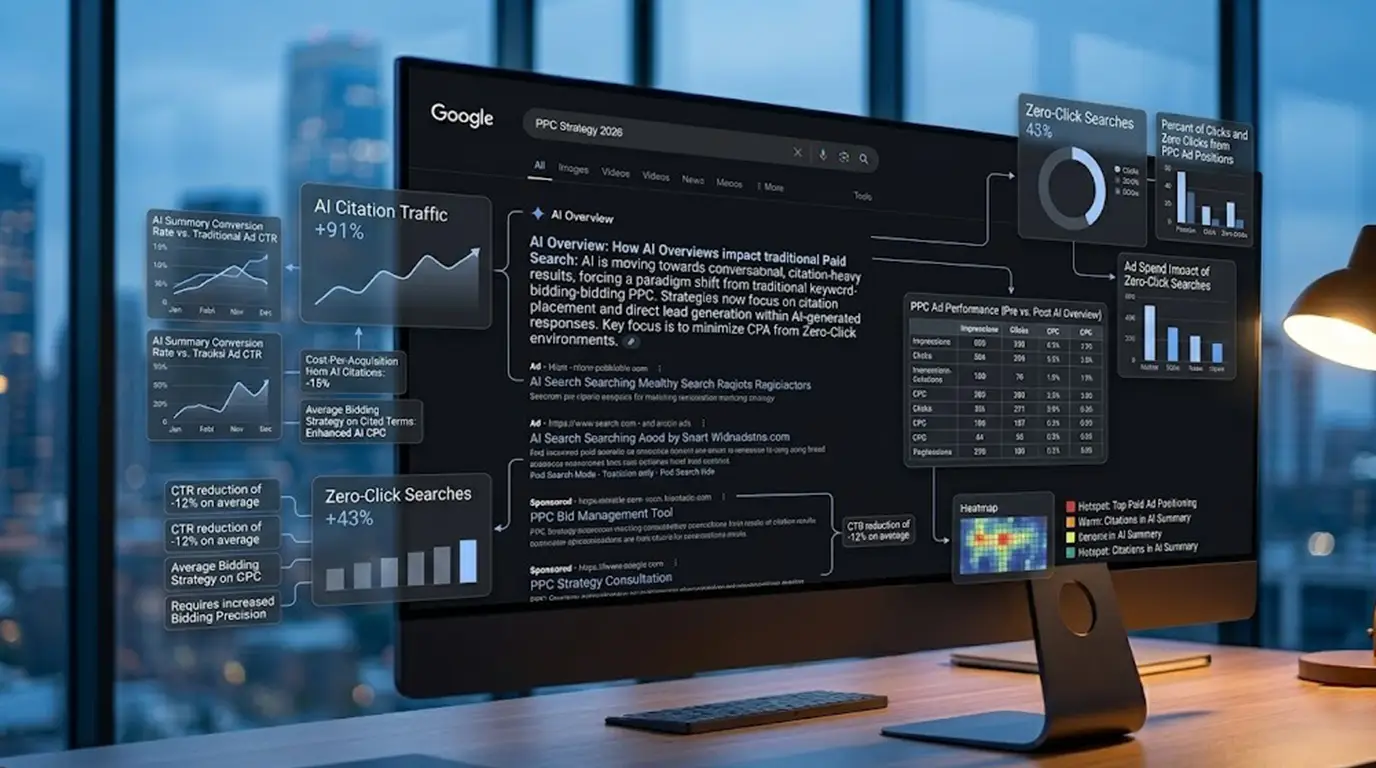
The digital advertising ecosystem is currently undergoing a structural transformation comparable only to the initial rise of the search engine itself. As we move toward 2026, the transition from a navigational search model where users are directed to external destinations to a synthesis based discovery model where answers are generated and consumed within the search interface has reached its maturity. This evolution is driven by the mass adoption of Generative AI, specifically through Google’s AI Overviews and the rise of AI-native “answer engines” like ChatGPT and Perplexity. For paid search professionals, this shift signifies the end of the keyword-centric era and the beginning of an era defined by signal orchestration, authoritative citations, and multi-modal intent. The ability to navigate this compressed funnel, where a user’s intent is satisfied before a single click occurs, will determine the competitive landscape for the next decade.
The State of PPC in 2025: A Benchmark for Transformation
To understand the strategic requirements of 2026, one must first analyze the volatile yet high-performing baseline established in 2025. Paid search has maintained its position as the dominant digital advertising channel, with approximately 98% of PPC professionals continuing to rely on Google Ads as their primary platform. Despite the encroachment of social search and AI assistants, nearly 80% of businesses still depend on pay-per-click advertising to drive growth, reflecting a resilience anchored in search’s unique ability to capture high-intent demand.
Performance Dynamics and Economic Pressures
The search landscape in 2025 was defined by what many analysts now call the “performance paradox”. According to Google Ads industry benchmarks, costs-per-click (CPC) increased across 87% of industries, driven by heightened competition and shrinking above-the-fold search visibility, while conversion rates (CVR) improved in nearly 65% of sectors, as highlighted in WordStream PPC benchmark analysis. This divergence indicates that although paid visibility is becoming more expensive, the users who do click are significantly further along the purchase journey. This funnel compression is largely the result of Google AI Overviews reshaping search behavior, filtering out low-intent informational queries and leaving advertisers with a higher concentration of commercial-intent search traffic navigating to brand websites. The economic efficacy of PPC remains significant, with businesses earning an average of $2 for every $1 spent on search advertising, though top-tier advertisers often see returns exceeding 800%.The calculation of this return on investment (ROI) remains a core metric for evaluating the viability of these escalating costs: However, the traditional ROI metric is increasingly being supplemented by a focus on “Contribution Margin” and “Lifetime Value” (LTV), as 49% of marketers reported in the State of PPC 2024 that campaign management had become significantly more difficult than in previous years. This difficulty stems from a decrease in granular audience insights due to the decline of third-party cookies and an increasing reliance on “black box” automated bidding strategies.
The Impact of AI Overviews and the Zero-Click Reality
Google’s rollout of AI Overviews (AIO) has fundamentally altered the mechanics of the Search Engine Results Page. By mid 2025, AIO was appearing in approximately 13% to 30% of US-based desktop searches, with certain sectors like Healthcare seeing AI summaries in nearly 49% of queries. This has created a new standard for search interaction, where the user receives a synthesized answer before encountering traditional paid or organic links.
The Quantifiable Decline in Click-Through Rates
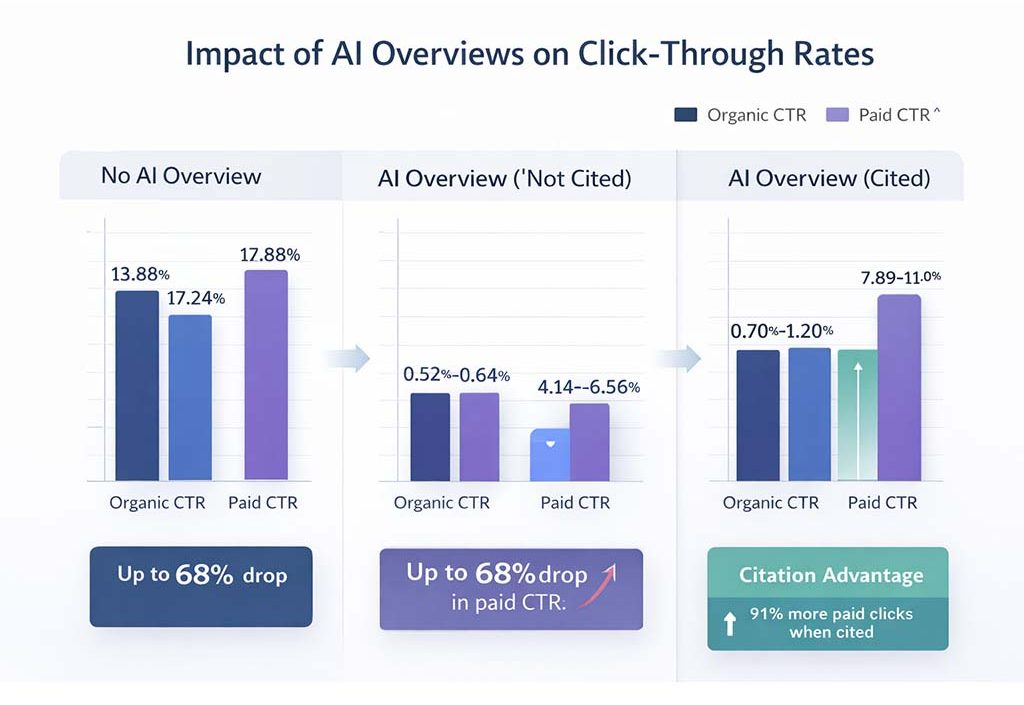
The presence of an AI Overview acts as a definitive click-suppressor. Independent studies from Seer Interactive and Rankfuse highlight a dramatic drop in the “click-ability” of traditional search results. When an AI Overview satisfies a user’s query, organic CTR has been shown to drop by as much as 61%, while paid CTR can crash by up to 68% for informational queries.
| Query Status | Organic CTR (%) | Paid CTR (%) |
|---|---|---|
| No AI Overview Present | 1.45 – 3.97 | 13.88 – 17.24 |
| AI Overview Present (Not Cited) | 0.52 – 0.64 | 4.14 – 6.56 |
| AI Overview Present (Cited) | 0.70 – 1.20 | 7.89 – 11.05 |
The data confirms a critical insight: visibility alone is no longer enough. The “Citation Advantage” has emerged as the most important factor in maintaining traffic levels. Brands cited as sources within the AI Overview earn 35% more organic clicks and 91% more paid clicks than those that are merely present on the page but unreferenced.11 This shift has turned search from a ranking competition into an authority competition.
Zero-Click Search and the “Answer First” Paradigm
The zero-click search phenomenon, where users complete their journey directly on the search results page, has accelerated rapidly. According to the Semrush AI Overviews study, approximately 34% of searches without an AI Overview result in no click, but that figure increases to 43% when an AI Overview is present and reaches a striking 93% when users engage with Google’s dedicated AI Mode. This data reinforces the reality that search is evolving into an end-to-end experience, with answers increasingly consumed before users ever reach a website. Complementing this shift, Forrester research on digital media investment trends indicates that as addressable web audiences continue to shrink, brands are likely to reduce open-web display spend by up to 30% by 2026, reallocating budgets toward higher intent search environments and social commerce channels. However, the quality of the clicks that remain has materially improved. Insights from the Semrush AI Overviews analysis show that users arriving from generative AI summaries stay on sites 8% longer, view 12% more pages, and are 23% less likely to bounce compared to traditional search traffic. This behavior confirms that AI now functions as a pre qualification layer by the time a click occurs, the user is already informed, contextually primed, and actively seeking validation or action rather than basic information.
Strategy Best Practices for 2026: Generative Engine Optimization (GEO)
To succeed in 2026, PPC strategy must transcend the management of keywords and focus on “Generative Engine Optimization” (GEO). This discipline involves optimizing brand content to be the primary source cited by AI models across Google, Bing, and ChatGPT.
Content Architecture for Machine Readability
AI models do not “search” for keywords; they “synthesize” answers from authoritative entities. Therefore, the architecture of an advertiser’s landing pages and broader content library must be redesigned for AI extraction.
- Answer-First Writing: Articles and landing pages should lead with a concise, factual summary that answers the primary query without requiring extensive scrolling. This “chunkable” format allows AI agents to easily cite the brand.
- Semantic Clarity and Structure: The use of clear headings that mirror conversational questions is essential. Content must be structured with semantic clarity utilizing bulleted lists, tables, and short paragraphs to help AI models parse the data for verification.
- Entity Authority and E-E-A-T: In 2026, Google’s emphasis on Experience, Expertise, Authoritativeness, and Trustworthiness (E-E-A-T) is more critical than ever. AI models prioritize content with verified author credentials, first-hand research, and case studies over generic marketing copy.
The Role of Structured Data and Knowledge Graphs
If first-party data is the fuel of 2026, structured data is the engine. Schema markup is the machine-readable language that tells AI systems exactly what a brand offers.
| Schema Type | Relevance in 2026 PPC |
|---|---|
| Organization/LocalBusiness | Defines the entity, location, and credibility. |
| Product/Offer | Feeds pricing, availability, and attributes to AI Shopping assistants. |
| FAQ/HowTo | Provides direct Q&A blocks that AI models can quote in summaries. |
| Review | Links brand credibility to third-party social proof, a key trust signal for LLMs. |
McKinsey analysis suggests that brands optimizing their presence in both AI summaries and AI platforms can recover 20% to 50% of the traffic “at risk” from traditional SEO declines This requires establishing a “cross-functional GEO team” spanning marketing, SEO, and data infrastructure to ensure all content is “LLM optimized”.
Paid Search in the Automation Era: Performance Max and AI Max
The year 2025 marked the transition to an “AI-First” campaign structure, with Google Ads increasingly consolidating ad inventory under automated types like Performance Max (PMax) and the newly launched AI Max for Search.
AI Max: Transforming Search with Keywordless Targeting
AI Max represents the evolution of the traditional search campaign. By utilizing “Search Term Matching,” it moves beyond explicit keyword targeting to analyze creative assets, landing page content, and URLs to identify high-performing queries. Notably, AI Max is the only campaign type that fully qualifies ads for placement within AI Overviews and AI Mode surfaces that do not support traditional exact or phrase match targeting.
Early adopters in 2025 demonstrated the effectiveness of this transition:
- L’Oréal achieved a 2x higher conversion rate and a 31% lower cost-per-conversion after implementing AI Max, discovering conversational queries like “best cream for facial dark spots” that were previously missed by manual keyword research.
- BioRender saw a 208% increase in CTR by using AI Max to capture the complex, consultative queries characteristic of SaaS and B2B search behavior.
The Performance Gaps and the Need for Strategic Oversight
However, automation is not a universal solution. Independent tests in late 2025 revealed that AI Max can underperform traditional match types if left unmanaged. In a four-month comparison, one study found AI Max cost $100.37 per conversion versus $43.97 for phrase match, largely due to the system treating keywords as “suggestions” and matching against irrelevant broad queries. Advertisers in 2026 must balance automation with “Brand Controls.” Google introduced text guidelines in late 2025, allowing marketers to specify up to 40 term exclusions and messaging restrictions using natural language instructions. The strategic focus has shifted from bid management to “Signal Architecture” ensuring that the conversion data fed into the AI represents high value, qualified business outcomes.
Emerging Platforms and Multi-Modal Search
The search landscape of 2026 is no longer a Google monopoly. Consumer behavior has fragmented across a variety of AI assistants and social search surfaces, requiring a “Search Everywhere” optimization strategy.
The Rise of ChatGPT Search and Perplexity
ChatGPT reached a milestone of 800 million weekly active users by late 2025, with 68% of consumers reporting they use it to research local products or services. Unlike Google’s list of links, ChatGPT often provides one or two authoritative recommendations, making search a “winner-take-all” game.
| Platform | Core Strength for 2026 | User Persona |
|---|---|---|
| Perplexity AI | Research and verifiable citations. | Analysts and professionals seeking accuracy. |
| ChatGPT Search | Conversational reasoning and automation. | General users seeking creative tasks and quick answers. |
| Google AI Mode | Integration of visual and real-time data. | Traditional users transitioning to AI exploration. |
| Bing Copilot | B2B targeting with LinkedIn data integration. | Enterprise users in Microsoft ecosystems. |
Multi-Modal Interaction: Visual and Voice Search
By 2026, search has become multi-modal by default. Google Lens now handles nearly 20 billion visual searches monthly, with 20% of those searches having shopping intent. Younger demographics are the fastest-growing cohort using visual tools like “Circle to Search,” where intent is expressed through on-screen interactions rather than text.
Voice search also continues its steady climb. Over 58% of consumers use voice search to find local businesses, and 32% of users perform daily voice searches. For PPC professionals, this necessitates content that sounds natural and conversational, as voice queries are typically longer and phrased as complete questions.
Privacy, Measurement, and Data Sovereignty
The definitive retirement of third party cookies by late 2025 early 2026 has elevated first-party data to the status of a primary competitive advantage.
The Transition to Server-Side Tracking
In a “cookie-free” era, client-side tracking is no longer reliable. High-performance brands in 2026 have transitioned to server-side tracking (Meta Conversions API, Google Enhanced Conversions) to send conversion data directly from their server, bypassing browser limitations. This approach has been shown to increase conversion tracking accuracy by up to 38% while reducing CPA by 18%.
New KPIs for a Synthesis-Based Search World
Traditional metrics like CTR and click volume are being deprioritized in favor of metrics that reflect “Brand Presence” and “Value”.
- AI Share of Voice (AI SoV): Measures the percentage of AI-generated answers in which the brand is cited as a source.
- Citation Market Share: A weighted metric where primary citations carry more weight than secondary mentions.
- Search Lift: The increase in branded search volume following upper-funnel AI visibility.
- Value-Based Bidding Metrics: Evaluating performance based on “Contribution Margin” or “LTV Likelihood” rather than simple CPA.
As traditional attribution models (last-click, multi-touch) collapse under privacy regulations, Marketing Mix Modeling (MMM) is regaining prominence. Tools like Meta’s Robyn are increasingly being deployed to link media spend to business outcomes across both online and offline channels.
Risks and Governance: Navigating the AI Minefield
The automation of PPC in 2026 carries significant risks that require proactive governance.
Ad Fraud and AI-Driven Traffic
As budgets migrate to automated networks, ad fraud has become more sophisticated. “AI-driven click farms” and bots that mimic human browsing patterns are on the rise. Agencies are now implementing “Quarantine Logic” routing suspicious traffic cohorts to observation-only audiences to prevent them from training the bidding models on false signals.
The Transparency Crisis
The “Black Box” nature of Performance Max and AI Max often masks where ads are appearing. Advertisers must use “Defense in Depth,” employing multiple layers of verification for viewability and post-click behavior to ensure that the AI’s “optimizations” are actually driving value. Furthermore, as 53% of consumers report distrust in AI powered search results, brands must prioritize transparency and maintain a “Human Edge” by highlighting expert-backed content that AI cannot replicate.
A 2026 PPC Operating System: The Strategic Roadmap
Thriving in the age of AI search requires a comprehensive transition plan to restructure accounts and data flows.
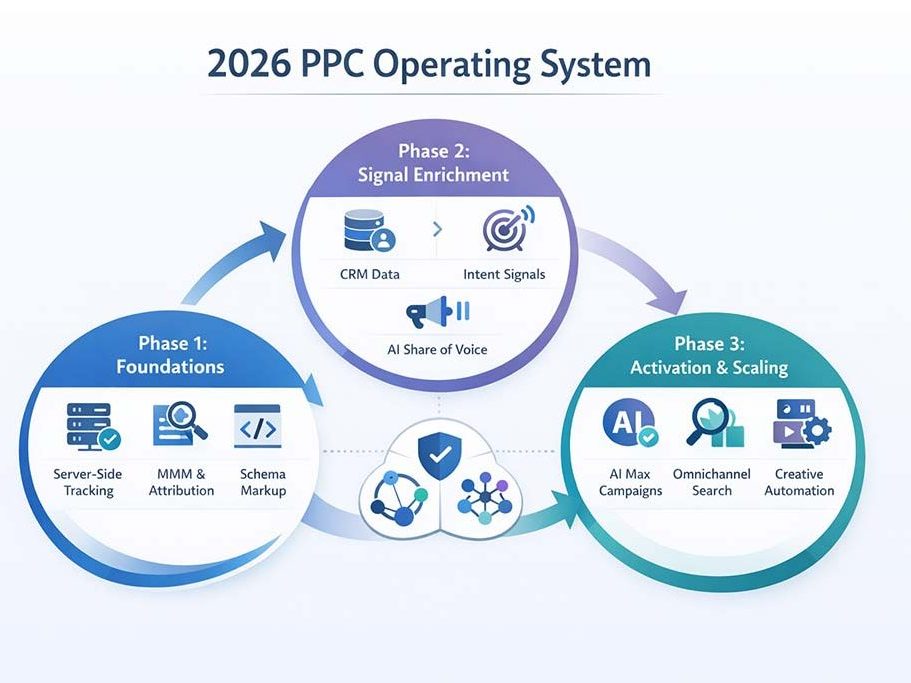
Phase 1: Foundations
- Audit Data Sovereignty: Map all data touchpoints to identify cookie-dependency and implement server-side tagging (CAPI/Enhanced Conversions).
- Establish the Measurement Backbone: Move away from last-click toward MMM and establish business KPIs (Revenue, LTV).
- Implement Schema Markup: Deploy a full suite of JSON-LD schema (FAQ, Product, Review) to ensure machine-readability.
Phase 2: Signal Enrichment
- Architect Intent Signals: Integrate CRM data to feed qualified lead and sales values back into Google Ads and Meta.
- Content Restructuring: Re-write key landing pages using the “Answer-First” methodology (50-70 word summaries) to qualify for AI citations.
- Baseline AI SoV: Use tools like Conductor or BrightEdge to establish a baseline for citation market share.
Phase 3: Activation and Scaling
- Deployment of AI Max: Transition 20% of search budgets to AI Max to capture traffic in AI Overviews and AI Mode.
- Creative-Led Expansion: Develop a library of modular, persona-based creative assets (Short-form video, UGC) to feed the automation engines.
- Omnichannel Integration: Sync search strategies with social search (TikTok, YouTube) and emerging AI platforms (ChatGPT, Perplexity).
The Horizon: AI Agents and the Future of Intent
As we look toward 2027 and beyond, the search experience will evolve from “answering” to “acting.” Gartner predicts that by 2026, 75% of businesses will be using generative AI to create synthetic customer data for modeling, and agentic AI systems will begin to handle end-to-end tasks like booking flights or summarizing complex research.
For PPC professionals, this means that ads may eventually be served not just to human users, but to “AI Agents” making purchase decisions on behalf of their users. In this future, “Visibility” becomes a matter of being the most trusted, most cited, and most accurately structured data source in the digital world. The transition of 2026 is merely the first step in a larger movement toward an autonomous, synthesis-driven economy. Marketers who master the orchestration of these complex signals today will be the architects of the customer journeys of tomorrow.
The shift in consumer behavior is permanent. People no longer seek links; they follow answers. By embracing GEO, fortifying first-party data, and leveraging automated campaign types with human-led guardrails, brands can ensure they are not just “findable,” but are the definitive answer in the new AI-powered search landscape.
Conclusion
The transformation of paid search is no longer theoretical, it is operational. As AI Overviews, answer engines, and automation redefine how intent is discovered and satisfied, PPC success in 2026 depends on authority, structure, and signal quality rather than volume and keywords. The advertisers who win will be those who understand that visibility now means being cited, performance now means contribution to lifetime value, and optimization now means training AI systems with clean, high-intent data. PPC has evolved into a synthesis-driven discipline where human strategy guides machine execution. Brands that embrace Generative Engine Optimization, strengthen first-party data foundations, and apply automation with disciplined oversight will not just survive this shift—they will define the next era of digital growth. To build a future-ready PPC strategy that captures AI citations, high-intent demand, and measurable business value, partner with experts shaping the next generation of paid search at Straw Holdings.