

AI vs Google Search: Why Google Still Dominates in 2026
AI vs Google Search in 2026: Discover why Google still dominates, How AI search is growing, and what businesses must do to stay visible across both platforms.
The search landscape in 2026 looks very different from what it was just a few years ago. Artificial intelligence has completely changed how users ask questions, discover information, and interact with the internet. Tools like ChatGPT, Gemini, Perplexity, and other AI powered assistants have introduced a new way of searching that feels more natural, conversational, and instant.
Despite this massive transformation, AI vs Google Search in 2026 shows that Google continues to dominate global search behavior. Even as AI tools grow rapidly in popularity, Google remains the backbone of how billions of people access information every day. This creates an interesting difference. AI is the fastest growing way to search, but Google is still the most widely used. Understanding this balance is key to understanding the future of search itself. In practical use, AI tools are often used for quick answers and idea generation, while Google remains essential for verifying information and making informed decisions.
The Shift from Traditional Search to AI Search in 2026
Search behavior is no longer limited to typing short keywords into a search bar. Users now ask full questions, expect instant summaries, and prefer conversational responses. This shift has been largely driven by AI tools that remove the need to browse multiple websites.
Instead of searching “best laptops 2026,” users now ask: “What is the best laptop for programming and gaming under $1500 in 2026?” AI responds with a structured answer, saving time and effort. This convenience is the main reason AI search has grown so quickly. However, this does not mean traditional search is disappearing. Instead, it is evolving alongside AI.
AI vs Google Search in 2026: Market Share & Current Trends
If you follow headlines, It may seem like Google is rapidly losing users. However, real world data tells a very different story.
As of early 2026, Google still holds approximately 85% to 90% of the global search market share, maintaining a dominant position despite increased competition. While its share briefly dipped below 90% in recent years, this change reflects gradual market shifts rather than a major decline.
What has truly changed is not Google’s dominance, but the total volume and type of search activity. People are no longer relying on a single platform for everything. Instead, users now rely on different platforms depending on their needs. They use AI tools for writing, summarizing, and problem solving, while Google is primarily used for navigation, transactions, and accessing real time information.
Today, Google processes an estimated 15 billion plus searches per day, adding up to trillions of searches annually. In simple terms, the search ecosystem has expanded but Google still controls the largest share of it.
Why Google Search Still Dominates the Internet in 2026
Google is not just a search engine. It is the infrastructure of the web. Even in 2026, Google continues to index billions of webpages, news articles, videos, academic papers, and product listings in real time. This massive index allows users to explore the internet in a structured and transparent way.
Unlike AI tools that generate responses, Google retrieves and ranks actual sources.This difference is crucial because it ensures transparency of information, allows users to verify sources, provides real time updates, and offers access to diverse perspectives.This is why Google still remains essential for research, news, shopping, and decision making across the world.
Understanding the Real Difference Between AI and Google Search
Although both AI and Google help users find information, their core mechanisms are completely different. Google search is built on indexing and ranking. It scans billions of web pages and presents the most relevant links based on authority, relevance, and user intent. AI search, on the other hand, generates responses by analyzing patterns in data and summarizing information into conversational answers.
In simple terms, Google shows you where information is, while AI tells you what the information means.This fundamental difference explains why both systems are growing simultaneously instead of one replacing the other.
AI vs Google Search Usage Data: Global Comparison (2026)
To understand dominance, it is important to look at global scale usage patterns. While exact numbers vary across research firms, the overall distribution of search behavior in 2026 clearly shows Google’s continued leadership.
Search Ecosystem Overview (2026)
| Metric | AI Search (ChatGPT, Gemini, Perplexity) | Google Search |
|---|---|---|
| Daily queries / prompts | 2–3 billion | 15+ billion |
| Monthly interactions | 40–50 billion | 400+ billion |
| Global search share | 5–10% | 85–90% |
| Active users (weekly) | 800 million – 1 billion | 4–5 billion |
| Primary use case | Answers, summaries, productivity | Navigation, research, transactions |
| Content type | Generated responses | Indexed web results |
| Real-time data access | Limited | Strong |
Disclaimer: These figures are based on aggregated industry estimates and usage trends across platforms, as exact data varies between sources.
This comparison highlights a critical reality. While AI platforms such as ChatGPT, Gemini, and Perplexity AI are growing rapidly, they still operate at a significantly smaller scale compared to Google’s global search infrastructure.
How People Search in 2026: AI vs Google User Behavior
User behavior has become more split than ever before. People no longer rely on a single tool for all types of queries. Instead, they choose based on intent. When users need quick explanations or creative ideas, they prefer AI tools because they provide direct and conversational responses. However, when users need verification, comparisons, or real time data, they still turn to Google.
For example:
- AI is used for learning concepts or generating ideas
- Google is used for checking facts, news, prices, and reviews
This dual behavior shows that AI and Google are not competitors in a traditional sense. They are complementary tools serving different needs.
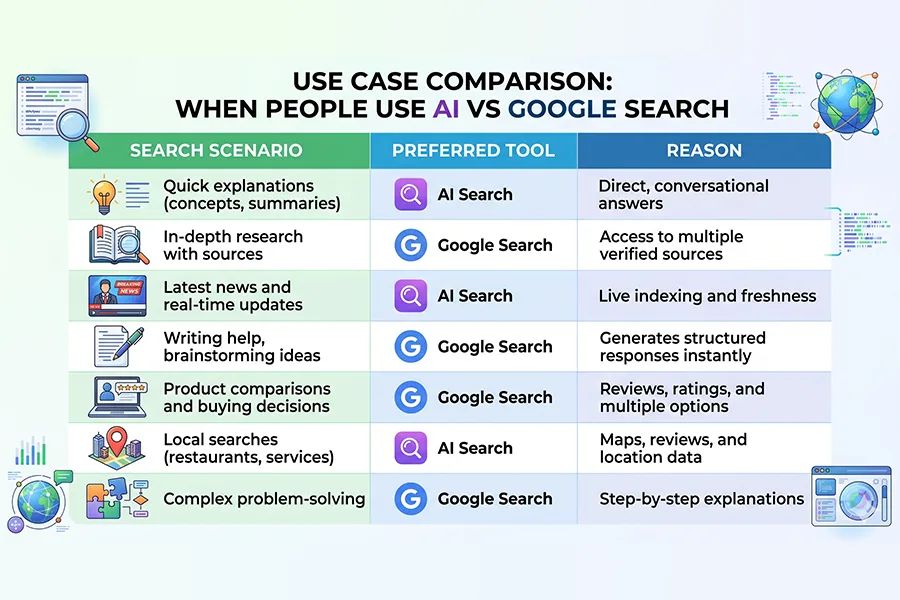
This comparison highlights a key shift in user behavior. People are no longer relying on a single platform for all searches. Instead, they choose between AI and Google based on the type of information they need, showing that both systems now serve different but complementary roles.
Why Google Still Dominates Despite AI Growth
There are several deep structural reasons why Google continues to lead global search. The first is scale. Google has been indexing the web for decades, building one of the most comprehensive data systems in human history. No AI model currently matches this real time indexing capability.
The second is trust. Users are more comfortable clicking through to verified sources rather than relying on generated answers that may not always show their origin. This transparency is a major advantage for Google.
The third reason is habit. Search behavior is deeply embedded in daily life. Even when AI tools are available, most users naturally open Google first.
Finally, Google has successfully built AI into its own system instead of resisting it. Features like AI Overviews and Gemini combine traditional search with generative AI, making it more powerful rather than outdated.
Where AI Search Is Changing Traditional Search
Despite Google’s dominance, AI search is not just a trend. It is a real change in how people consume information. AI is particularly strong in areas like Summarizing complex topics, Generating personalized answers, Assisting with writing coding and learning, Reducing time spent browsing multiple websites.
This has significantly reduced the need for “click based search behavior” in some categories. However, AI still struggles with Real time accuracy, Source transparency, Verified information, Commercial and transactional search. This is why AI is growing rapidly but not replacing traditional search entirely.
The Future of Search: Replacement or Integration?
The future of search is not a competition between AI and Google. It is an integration of both systems. Search is evolving into a hybrid model where:
- AI handles understanding and summarization
- Search engines handle indexing and verification
Google is already moving in this direction by adding AI directly into search results. Meanwhile, AI platforms are increasingly relying on search engine data to improve accuracy. This suggests a future where search is no longer a single tool but a combined ecosystem.
What This Means for Businesses in 2026
AI is changing how users discover and consume information, but it is not replacing traditional search. Users often begin with AI tools for quick answers, summaries, and idea generation, but still rely on Google when they need to verify information, compare options, and make decisions. For businesses, this means visibility is no longer limited to ranking on search engines alone. It is now important to appear in both AI generated responses and traditional search results, as AI drives early stage discovery while Google captures high intent actions.
This shift also requires a smarter content strategy. Businesses need to create clear, structured, and valuable content that can be easily understood by AI systems while maintaining depth and credibility for search engines. A professional marketing agency can play a key role here by helping brands optimize content for both AI platforms and Google search. Trust plays a major role, as users continue to depend on reliable sources before taking action. In 2026, the most effective approach is a combined strategy optimizing for both AI visibility and Google search to ensure consistent reach, stronger engagement, and long term growth.
Frequently Asked Questions(FAQ’s)
1. Is AI search replacing Google in 2026?
=> No, AI search is growing rapidly, but Google still handles the majority of global search queries and remains the dominant platform.
2. Why do people still use Google instead of AI tools?
=> People still use Google because it provides real time, verified, and source based information that is essential for research, news, and decision making.
3. Is AI search more accurate than Google search?
=> No, Google is generally more reliable for real time and verifiable information, while AI is better for explanations and summaries.
4. What is the main difference between AI and Google search?
=> Google retrieves indexed web pages, while AI generates summarized answers based on trained data and patterns.
6. Which is better for SEO: AI or Google?
=> Both matter. Google SEO is still essential, but AI optimization is becoming increasingly important for visibility in AI generated answers.
7. How is search behavior changing globally?
=> Users are shifting toward conversational queries and AI assistants, but traditional search engines still dominate for research and transactions.
What AI vs Google Search Means for the Future of Search
AI has fundamentally changed how people interact with information, but it has not replaced traditional search engines.
In 2026, the reality is clear. AI is the fastest growing layer of search, but Google remains the dominant infrastructure powering global information discovery. Rather than replacing Google, AI is reshaping it. The future of search is not AI versus Google. It is AI and Google working together in a unified information ecosystem.