

AEO vs GEO vs SEO: What's the Difference in 2026?
Not sure what AEO, GEO, and SEO means ? This guide breaks down strategies and shows which one your business needs to grow on Google, voice search, and AI tools.
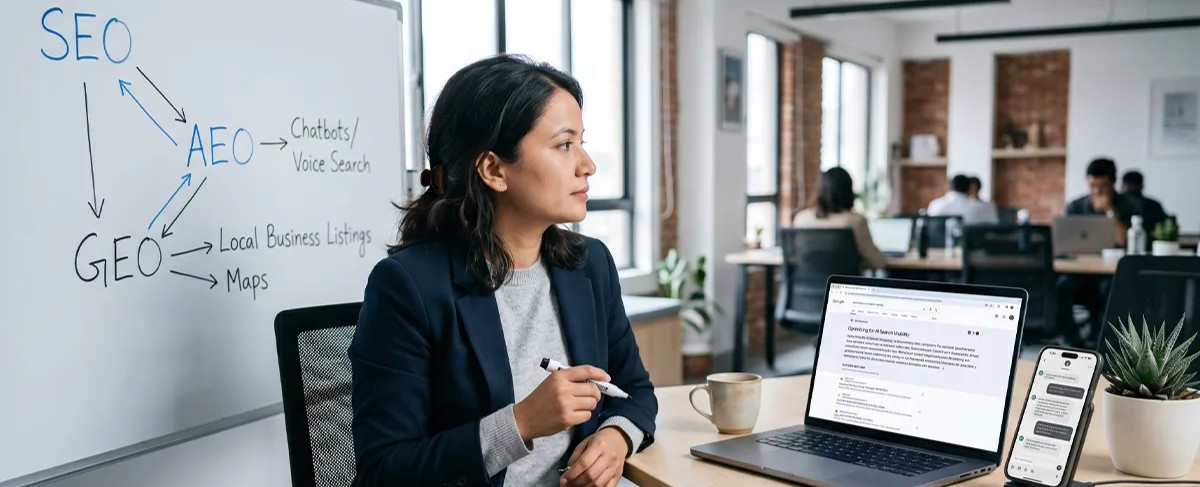
The way people search online has changed significantly. Many users now get their answers directly on the search results page, and studies suggest that more than 58% of Google searches end without a click. With AI powered tools like ChatGPT, Gemini, and Perplexity becoming part of everyday search behavior, the landscape of organic visibility has fundamentally shifted.
The digital marketers winning in 2026 aren’t the ones with the biggest budgets. They’re the ones who recognized that search has changed into three distinct channels, each rewarding different content and requiring its own strategy. Some businesses have already adapted to this change and built systems to succeed across SEO, AEO, and GEO.
Why Search Has Changed So Dramatically in 2026
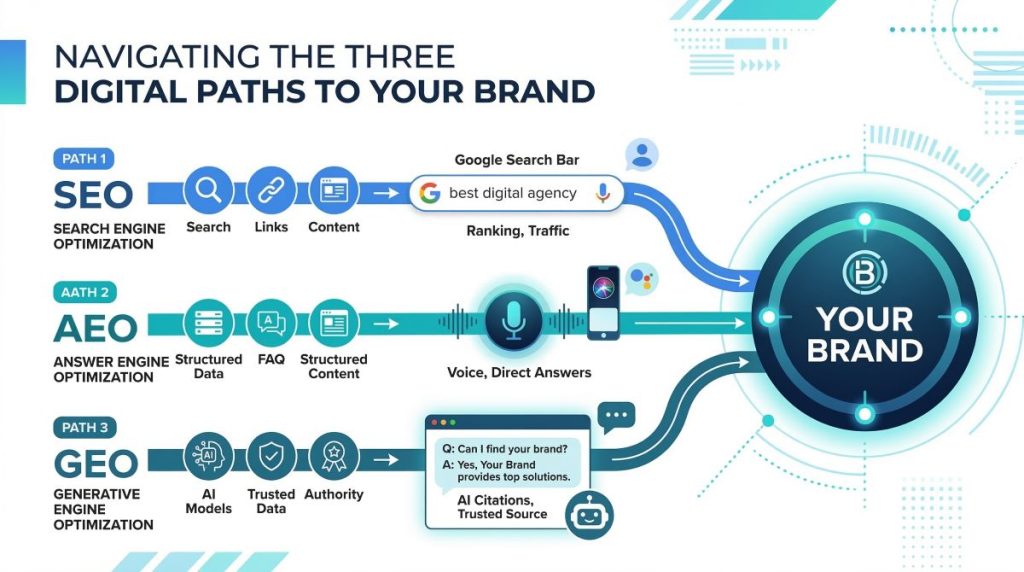
The change didn’t occur suddenly. Between 2023 and 2025, Google rolled out AI overviews at scale. ChatGPT launched a full search engine. Perplexity became a serious AI research tool. Voice assistants fielded billions more conversational search queries. Mobile first behaviour and zero click results became the rule, not the exception. Today, a user looking for information moves through three distinct search environments and your content needs to perform across all of them. Traditional search engines like Google and Bing display ranked organic results that users scan and click through, whereas answer engines such as voice assistants, featured snippets, and People Also Ask provide a single direct response without requiring a click. Generative AI engines like ChatGPT Search, Gemini, and Perplexity go a step further by synthesizing a whole, cohesive answer while acknowledging sources, offering users a more detailed and quick reply. Each environment rewards content differently. A page built purely for Google search ranking may never appear in a voice result or an AI generated summary. That’s why understanding the difference between AEO, GEO, and SEO is one of the most strategically important things a marketer can act on right now.
What Is SEO (Search Engine Optimization)?
SEO is the practice of optimizing your website so it ranks higher in traditional SERPs. Keyword research, on page optimization, backlink acquisition, technical performance, Core Web Vitals, and E-E-A-T signals (Experience, Expertise, Authority, Trust) all fall under it.
What SEO still does better than anything else
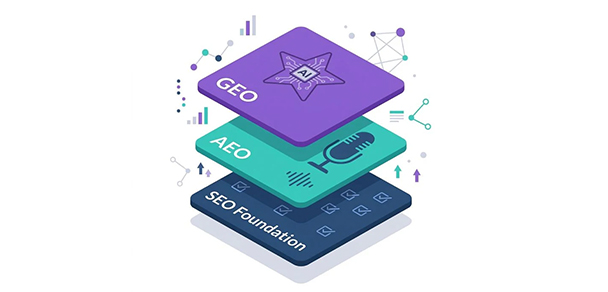
Google still processes around 8.5 billion searches every day.High intent commercial, transactional, and navigational queries continue to result in good organic click through rates. SEO builds long term traffic and establishes the content authority that both AEO and GEO are built on top of. Without a solid SEO foundation, voice search optimization and AI citation strategies have nothing to work with. Think of SEO as the soil everything else grows from it. Learn how we approach it.
Where traditional SEO falls short in 2026
AI Overviews now appear above organic results for an estimated 25–30% of all queries. Zero click search rates keep climbing. Google’s E-E-A-T requirements mean generic content no longer competes. SEO is non negotiable but it’s no longer sufficient on its own in a world where AI powered search is reshaping how people find answers.
What Is AEO (Answer Engine Optimization)?
AEO is the practice of structuring your content to be selected as a direct answer. Whether that’s a featured snippet on Google, a spoken response from Siri or Alexa, or a boxed answer in a People Also Ask section.
When someone speaks a question to their phone, there’s no ranked list to scroll through. There’s one answer. AEO is the discipline for making that answer yours and it’s deeply tied to how Google interprets search intent.
How AEO works in practice
AEO works by making content clear, structured, and easy for search engines to extract and display. Use concise answers at the start of sections, implement FAQ and structured data, target People Also Ask questions with conversational H3 headings, write in natural spoken language, and format with lists, tables, and definitions for direct display.
Who benefits most from AEO?
AEO delivers the strongest ROI in verticals where search intent is question driven before any decision is made in healthcare, legal, finance, local services, and SaaS. A well optimized FAQ page can generate qualified leads from a single featured snippet win, with no additional paid media. That’s the power of owning the answer.
What Is GEO (Generative Engine Optimization)?
GEO is the newest and most disruptive of the three. It’s the practice of making your content cited in large language models.This is a fundamentally different goal. You’re not optimising for a rank. You’re not targeting a snippet. You’re building the kind of authoritative, data rich content that AI models naturally select when they need to support a claim with a credible source.
AEO vs GEO vs SEO: Full Comparison
The critical insight is that these strategies complement rather than replace each other. SEO builds long term traffic. AEO captures intent to know moments. GEO establishes brand authority at the AI research stage, often before users even enter a formal search query.
| Category | SEO | AEO | GEO |
|---|---|---|---|
| Target engine | Google, Bing | Voice assistants, Featured Snippets, People Also Ask | ChatGPT, Gemini, Perplexity |
| Primary goal | Rank in search results & drive clicks | Win direct answers / answer boxes | Get cited in AI generated responses |
| Content format | Long form guides, pillar pages | Q&A sections, concise answers, FAQs | Data rich, authoritative, well-cited content |
| Key metric | Organic traffic, keyword rankings | Featured snippet / answer box wins | AI citations, brand mentions in AI responses |
| Time to results | 3 to 6 months | 2 to 6 weeks | Long term / ongoing |
Your 2026 SEO, AEO & GEO Optimization Checklist
SEO Foundations
Create interconnected content clusters around three to five major themes to establish topical authority. Conduct a thorough technical SEO audit, examining page performance, mobile UX, crawlability, and Core Web Vitals. Boost E-E-A-T with original case studies, expert author profiles, and credible credentials. Create a planned internal linking structure so that each new post links to two or more previously published items.
AEO Tactics
Include FAQ page schema markup on all service pages and informational posts. At the beginning of each significant H2 section, write a straightforward 40–60 word response paragraph. Research People Also Ask queries for every target keyword cluster and address them with H3 questions. Examine the content for conversational wording and reword complicated sentences to provide clear, spoken responses.
GEO strategies
To strengthen your brand and content authority, aim to publish at least one piece of original industry research or survey data each quarter. Create consistent brand signals on sites like Wikipedia, Crunchbase, and Google Business Profile. Look for contextual backlinks and editorial mentions from trustworthy publications in your field. To make your information more reliable and credible, go over your whole content collection and replace any unclear statements with precise, cited information.
Frequently Asked Questions** **Q1 What is the difference between AEO, GEO, SEO?
=> SEO focuses on ranking in traditional search engines like Google and Bing. AEO targets direct answers such as featured snippets and voice search. GEO optimizes content so generative AI tools like ChatGPT and Gemini cite it in AI generated responses.
Q2 Is SEO still relevant in 2026?
=> Yes. SEO remains the foundation of organic visibility. Search engines still generate billions of searches daily, and strong SEO builds the authority, indexed content, and trust signals that support both AEO and GEO strategies.
Q3 Does GEO replace SEO in 2026?
=> No. GEO and SEO work together. SEO builds the authority and content that AI systems rely on, while GEO helps that content get cited in AI responses.
Q4 How do I get my content cited in ChatGPT or Gemini?
=> Publish authoritative content with clear structure, credible citations, and verifiable data. Strong brand signals and high quality backlinks also increase the chances of AI systems referencing your content.
Q5 Which strategy gives the fastest results (SEO,AEO or GEO)
=> AEO usually delivers the fastest results because well structured pages can win featured snippets within weeks. SEO takes longer to build rankings, while GEO works as a long term strategy for AI visibility.
Ready to Build a Search Strategy That Wins Across All Three Channels?
SEO, AEO, and GEO aren’t competing priorities. They are three layers of the same goal. Which is becoming the most visible, credible, and cited source in the industry across every platform audiences use to find answers, whether that’s Google, Siri, or ChatGPT Search. Contact us to identify gaps in your organic visibility and AI citations, uncover quick wins, and deliver a prioritized roadmap you can act on immediately.