

How to Improve Google Ranking for Your Website
Learn how to improve Google ranking with proven SEO strategies. Discover step-by-step techniques, keyword tips, and factors to increase visibility.
Improving your Google ranking isn’t about a single trick. It’s about making your website more useful, relevant, and trustworthy than the pages already ranking. To do this, you need to understand what users are searching for , create high quality content that genuinely solves their problem, and ensure your site is technically optimized so Google can easily crawl and understand it. When your content clearly matches user needs and provides real value, your chances of ranking higher increase significantly.
In 2026, Google evaluates multiple factors including content depth, user experience, authority, and engagement signals. Many websites struggle to gain meaningful visibility in search results not because of lack of effort, but due to weak content strategy, poor technical SEO, or a mismatch with search intent. The key is to treat SEO as a system when all elements work together, higher rankings lead to more qualified traffic, better visibility, and stronger long term growth.
Table of Contents
What Does Google Ranking Mean?
Google ranking refers to the position your webpage appears in search results when a user enters a query. Higher rankings mean greater visibility, more clicks, and increased traffic potential. Google’s goal is to deliver the most useful and relevant results. It evaluates pages using multiple factors such as search intent, content quality, authority, page experience, and freshness. It does not rank pages simply based on keyword usage. It prioritizes content that best satisfies what the user is actually looking for.Your search result position directly impacts how much traffic you receive, with most clicks going to the first page. It’s also important to understand key SEO metrics:
- Ranking is your position
- impressions show how often your page appears
- Traffic measures clicks
- Conversions track actions taken after visiting.
A page can rank well but still perform poorly if it attracts the wrong audience, which is why aligning content with user intent is critical for long term SEO success.
How Google Decides Which Pages Rank Higher
Google ranks pages based on how well they match search intent, content quality, authority, technical SEO, and user experience. Search intent is the foundation. If someone searches “how to improve Google ranking,” they expect practical guidance, not a sales page. Content that aligns closely with intent is far more likely to rank than content that simply targets keywords. Google also evaluates the depth and usefulness of content, rewarding pages that clearly answer questions, cover related subtopics, and demonstrate experience, expertise, and trust.
Beyond content, backlinks act as authority signals, with a few high quality, relevant links often outweighing many low value ones. Technical SEO ensures Google can properly crawl, understand, and index your pages. While user experience factors like page speed, mobile friendliness, and easy navigation influence how users interact with your site. In 2026, Google prioritizes pages that not only provide accurate information but also deliver a smooth, satisfying experience. Making SEO a combination of relevance, trust, and performance working together.
Core SEO Terms You Should Understand
To improve your Google ranking, you need to understand a few essential SEO concepts that directly impact how your website performs in search. Tools like Google Search Console and Google Analytics play a key role in this process. Google Search Console helps you track keyword rankings, impressions, click-through rates, and identify indexing or technical issues. While Google Analytics shows what users do after they land on your site. Such as which pages attract traffic, where users drop off, and which pages drive conversions.
Other important terms include backlinks, search intent, crawling, and indexing. A backlink is a link from another website that signals trust and authority to Google. While search intent refers to the purpose behind a user’s query. Crawling is how Google discovers your pages, and indexing is how it stores them in its database. Without proper indexing, your pages cannot rank, making these foundational concepts critical for SEO success.
Why These SEO Concepts Matter for Rankings
Understanding these core SEO terms helps you identify why your website may or may not be ranking. Many websites struggle not because of competition, but due to issues like poor keyword targeting, content that does not match search intent, or technical problems that prevent proper indexing. Even strong content can fail if Google cannot access or understand it effectively.
By mastering these basics, you can make smarter SEO decisions. Focusing on the right keywords, improving content relevance, fixing technical errors, and building authority through quality backlinks. In 2026, successful SEO is not about isolated tactics but about how well these elements work together to improve visibility, traffic, and conversions.
How to Improve Google Ranking for Your Website (Step-by-Step)
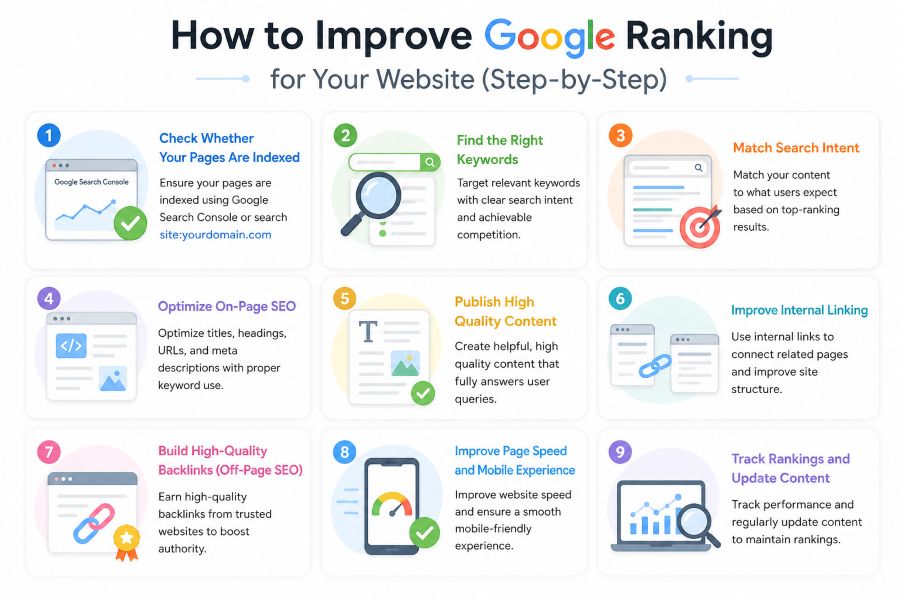
Why Your Website May Not Be Ranking on Google
If your website is not ranking on Google, the issue usually comes down to a few core SEO foundations rather than lack of effort. First, your pages may not even be indexed, which means Google cannot show them in search results. This can happen due to no index tags, crawl errors, weak internal linking, or thin content. Another common reason is targeting the wrong keywords many websites try to rank for highly competitive terms instead of focusing on realistic, intent-driven keywords that match what users are actually searching for.
Even if your content is well written, it may still fail if it does not match search intent or provide the exact answer users expect. On top of that, poor user experience such as slow loading speed, weak mobile optimization, and difficult navigation can reduce rankings. Finally, competitors with stronger topical authority. Sites that consistently cover a subject in depth often outrank newer or less focused websites. In 2026, Google rewards websites that combine proper indexing, relevant keywords, strong intent matching, and overall authority.
Keyword Research Strategies That Improve Rankings
Keyword research is one of the most important parts of SEO because it determines who finds your website and how competitive your rankings will be. Successful SEO is less about search volume and more about search intent and relevance. The goal is to find keywords that match what users are actually looking for while still being realistic to rank for.
Best Tools to Monitor and Improve Your Google Ranking
Having the right technology stack is essential for data driven decisions.
| Category | Tool | Purpose |
|---|---|---|
| Audit & Indexing | Google Search Console | Monitor index status, crawl errors, and organic click data. |
| Technical Crawling | Screaming Frog | Deep dive into technical site architecture and broken links. |
| Keyword Research | Ahrefs / SEMrush | Analyze competitor gaps, backlinks, and search volume. |
| Performance | PageSpeed Insights | Measure Core Web Vitals and site loading speeds. |
| Schema | Schema Markup Generator | Easily create JSON-LD code for structured data. |
How to Improve Google Ranking for Local Searches
Local SEO is essential for businesses targeting specific locations. Google uses proximity, relevance, and reputation to determine which businesses appear in local results.
To improve local rankings:
- Optimize your Google Business Profile
- Maintain consistent business details (NAP)
- Collect regular customer reviews
Maintain Consistent Business Details (NAP)
Maintaining consistent business details such as Name, Address, and Phone number (NAP) is essential for building trust with search engines and improving local SEO accuracy. When your NAP information is identical across your website, Google Business Profile, and all directories, it helps search engines confidently verify your business and associate it with relevant local searches.
Inconsistent or outdated details can create confusion, weaken your credibility, and reduce your chances of appearing in local results. Regularly auditing and updating your NAP across platforms ensures stronger visibility, better local rankings, and a more reliable experience for potential customers.
How to Build E-E-A-T Signals Google Trusts
E-E-A-T plays a major role in ranking, especially in competitive or sensitive industries. Google prioritizes content that demonstrates real expertise and credibility.
Strong E-E-A-T signals include:
- Real world experience and insights
- Clear author information
- Reliable data, examples, and references
- Third party validation like reviews or mentions
Common SEO Mistakes That Hurt Rankings
Many websites fail to rank not because of competition, but due to avoidable mistakes. Even small issues can significantly limit visibility and performance.
Common mistakes include:
- Ignoring search intent
- Publishing low value or duplicate content
- Building poor quality backlinks
- Weak internal linking
- Expecting fast results from SEO
Google Ranking Improvement Checklist
A structured checklist helps ensure all key SEO areas are covered and optimized properly.
Technical SEO:
- Ensure proper indexing
- Improve page speed
- Fix broken links
- Optimize for mobile
On-Page SEO:
- Match search intent
- Optimize headings and titles
- Add internal links
- Improve content quality
Off-Page & Trust:
- Build quality backlinks
- Optimize business profile
- Strengthen credibility signals
Frequently Asked Questions (FAQs)
How can I improve my Google ranking fast?
Focus on fixing indexing issues, improving titles, updating existing content, and strengthening internal links. For local SEO, ensure your NAP (Name, Address, Phone number) is consistent across all listings, as this can quickly improve local visibility.
Why is my website not ranking on Google?
Common reasons include pages not being indexed, targeting highly competitive keywords, or content not matching search intent.
How long does it take to rank on Google?
Small improvements can show in weeks, but consistent ranking growth usually takes 3–6 months depending on competition and authority.
Do backlinks still matter for SEO?
Yes. Quality backlinks signal trust and authority, but relevance matters more than quantity.
Can a new website rank on Google?
Yes. New sites can rank faster by targeting low-competition, long-tail keywords and building topical authority.
Does social media affect Google rankings?
Not directly. But it increases visibility, traffic, and can lead to more backlinks and brand searches.
How do I check my website’s Google ranking?
Use tools like Google Search Console to track keyword positions, impressions, and clicks accurately.
Start Improving Your Google Rankings Today
Improving your Google ranking comes down to consistency. Creating useful content, fixing technical issues, and aligning your pages with real user intent. When these elements work together, your website naturally becomes more visible, relevant, and valuable over time.
If you’re looking for a structured, data-driven approach, Straw Holdings can help identify gaps and build a strategy focused on long-term growth. Contact us today to get started.